



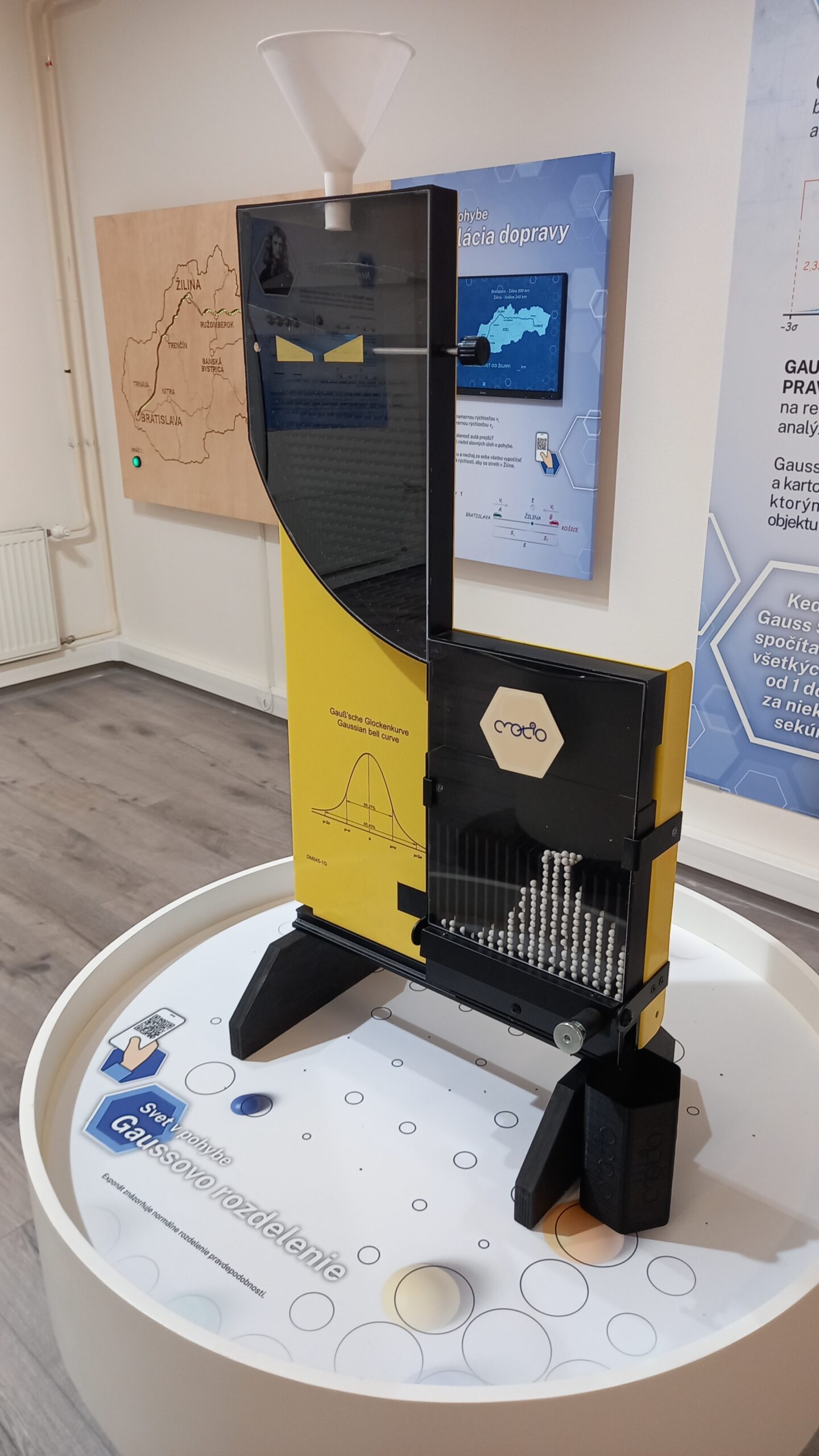
Operating Instructions:
- The device is permanently in working condition, always ready for operation.
- If the balls are in the device, place the provided container on the right side of the exhibit, under the discharge opening. Tilt the stopper (up) so that the balls pour into the container.
- If this does not happen automatically, return the stopper to its original position, with the outer cover vertical and the handle perpendicular to the wall of the exhibit.
- Slowly pour the contents of the container with the balls into the funnel at the top of the exhibit assembly and place the empty container to the right of the output opening.
- Gravity will take care of the subsequent action, where the balls will fall through the system of Pascal’s triangles into the chambers at the lowest part of the assembly.
- The resulting pattern should be a projection of the Gaussian curve characteristic of the normal distribution of values, in this case, the balls.
- You can repeat the experiment multiple times to check for accuracy.
Interactivity:
Small balls are put into the chamber through the hopper, from where they fall through transversely placed pegs. After sliding through a circular cutout and falling to the lower level of the next chamber, they are caught and automatically layered in comb-like partitions. They create the appearance of a side projection of a bell – the Gaussian distribution. The slider in the first chamber allows for horizontal adjustment of the ball drop position. After tilting the bottom strip, the balls are available again and can be used for the experiment with other observers.
This method can describe, for example:
Brownian motion of molecular particles, the probability of their occurrence, or random measurement errors, or deviations from the nominal size of products.
Educational Significance:
One of the most important probability distributions of a continuous random variable is the Normal probability distribution, also known as Gaussian, as it was discovered by the famous mathematician Carl Friedrich Gauss (1777 – 1855). He is often mentioned in connection with random errors, such as measurement errors caused by many unknown and mutually independent causes. Therefore, the normal distribution is also referred to as the law of errors. The term ‚normal‘ refers to the older meaning of „governing by law or model.“ The distribution of some physical and technical quantities is governed by this law. The distribution of measurement results relative to the reference value is characterized by the Gaussian curve. It is one of the most important probability distributions of a continuous random variable.
