



Operating Instructions
Interactivity
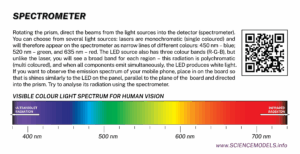
Not only sunlight but also halogen light consists of all colours of the visible spectrum, and this part of the exhibit allows you to demonstrate that. The spectrum contained in the radiation and the way the optical prism disperses light are clearly and visually displayed on the monitor as a spectral graph. Visitors control the light input parameters by adjusting the movable elements of the exhibit.
Educational Significance
At first glance, daylight seems to have no colour. This fact went unquestioned for centuries, and few people gave it much thought. In darkness, everything appears colourless. So why do colours emerge when illuminated? The sky changes colour depending on the weather (azure, white, grey) or time of day (red, blue, black). Nature changes its appearance with the seasons, people wear different clothes, and animals are either brightly colored or camouflaged. Add to those cars, houses, objects, and countless other things – where does this colourful diversity come from?
It was Isaac Newton who peeked behind the curtain of this grand spectacle. By observing sunlight passing through an optical prism, he discovered that white light is composed of a spectrum of colours. He announced this to the world in his 1672 work on optics, where he also explained the principles of rainbow colours. Today, we know that light behaves both as a wave and as a stream of photon particles. The part of the spectrum (waves) that an object reflects determines the colour we perceive it to be.
The interactive composition titled Spectrometry – Composition of Light allows visitors to explore the dispersion of a light beam into its colour spectrum and analyse the phenomenon firsthand.