



Operating Instructions
- The exhibit is permanently in working condition and ready for use at any time.
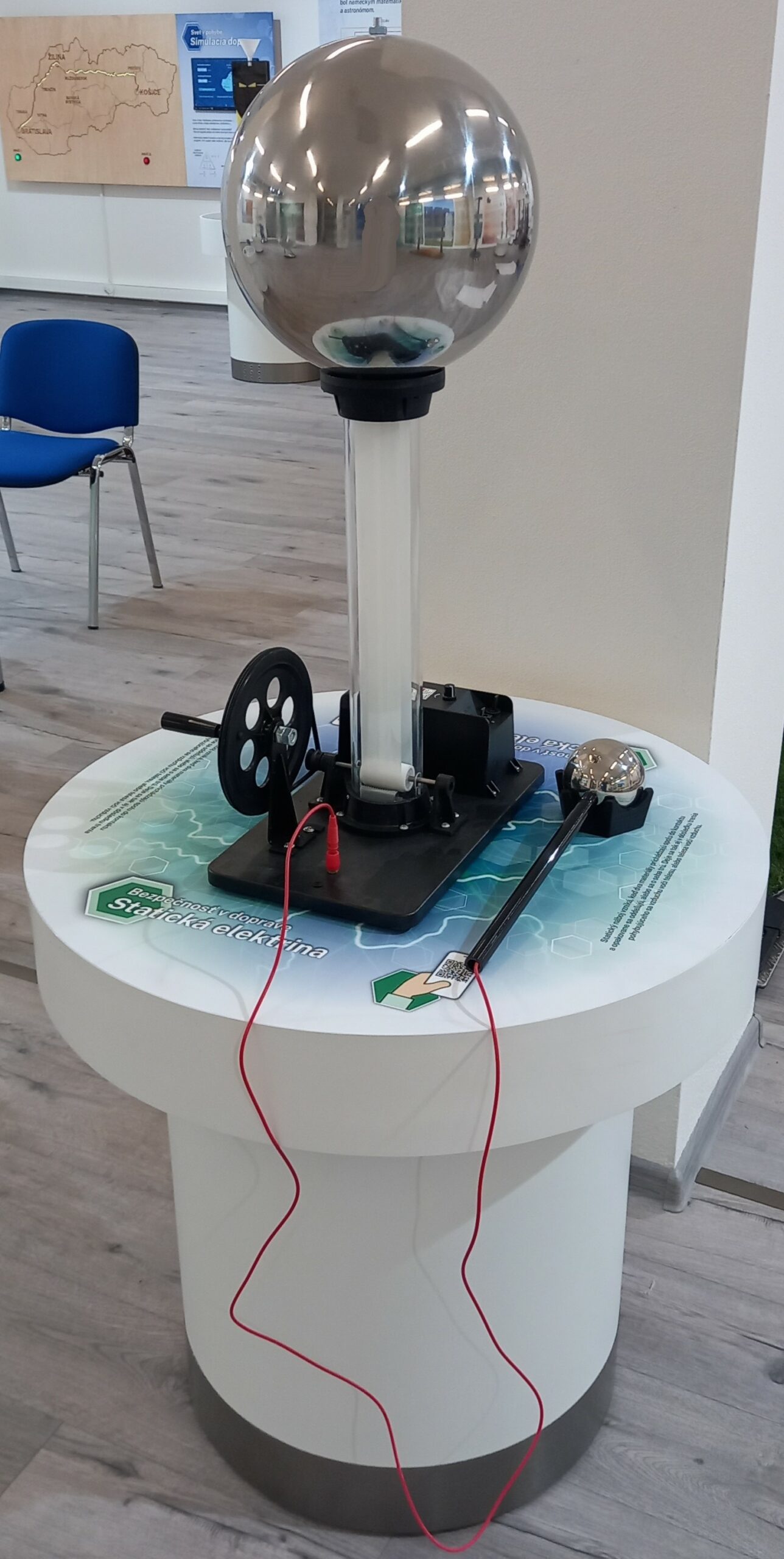
- Before starting, grasp the rod connected to a cable by its insulating tube/handle and gently touch the larger sphere with the rounded end — this gets rid of any residual electric charge in the system.
- Then move the rod away while still holding it or place it on the table without making contact with the apparatus.
- Use the crank wheel to rotate the system, which charges it through friction with static electricity. This charge accumulates on the surface of the large sphere.
- By bringing the small sphere (held by the rod) close to the large one, a discharge occurs between the metal bodies — a spark jumps across the short distance.
- At that moment, the potential difference is equalized.
Interactivity:
The exhibit consists of a Van de Graaff generator. The dominant metal sphere is located at the end of a cylinder through which a moving dielectric belt passes. It is driven by an external crank connected to a pulley. Friction generates an electrostatic charge that is transferred to the surface of the sphere. When a negatively charged striker is brought close, a striking discharge occurs. In addition to using the striker to produce a spark discharge, visitors can also touch the sphere with their hand to become charged. The charge is then transferred to the visitor’s body, which may result in a spark discharge between people who touch each other.
Educational Purpose – Concept of the Exhibit:
Static charge is generated when two materials come into contact and are repeatedly separated or rubbed together. This also occurs due to friction between moving air and a body, or vice versa. Microparticles of silicon in the environment are particularly problematic. For a long time, people experienced unpleasant shocks when touching their car after exiting a vehicle, when a small but uncomfortable discharge passed through the human body. Aircraft suffered from this phenomenon to a much greater extent. Charged particles on their surface returned to the ground with opposite polarity. Upon landing, there was a real risk of fire from a sudden discharge when positive and negative charges met in a strong spark. The greater the pressure or speed of separation, the greater the charge. The biggest issue arises in low-humidity environments. By studying material properties and modifying design and construction elements, engineering teams have made noticeable progress in eliminating this phenomenon. These include not only special “antennas” on aircraft wings but also tire materials that help discharge unwanted static from the vehicle. The same applies to seat upholstery — while friction cannot be completely avoided, choosing the right materials can minimize its effects. Visitors can safely observe what a static discharge looks like — and what it can do to their hair — thanks to this educational device: the Van de Graaff generator.
