



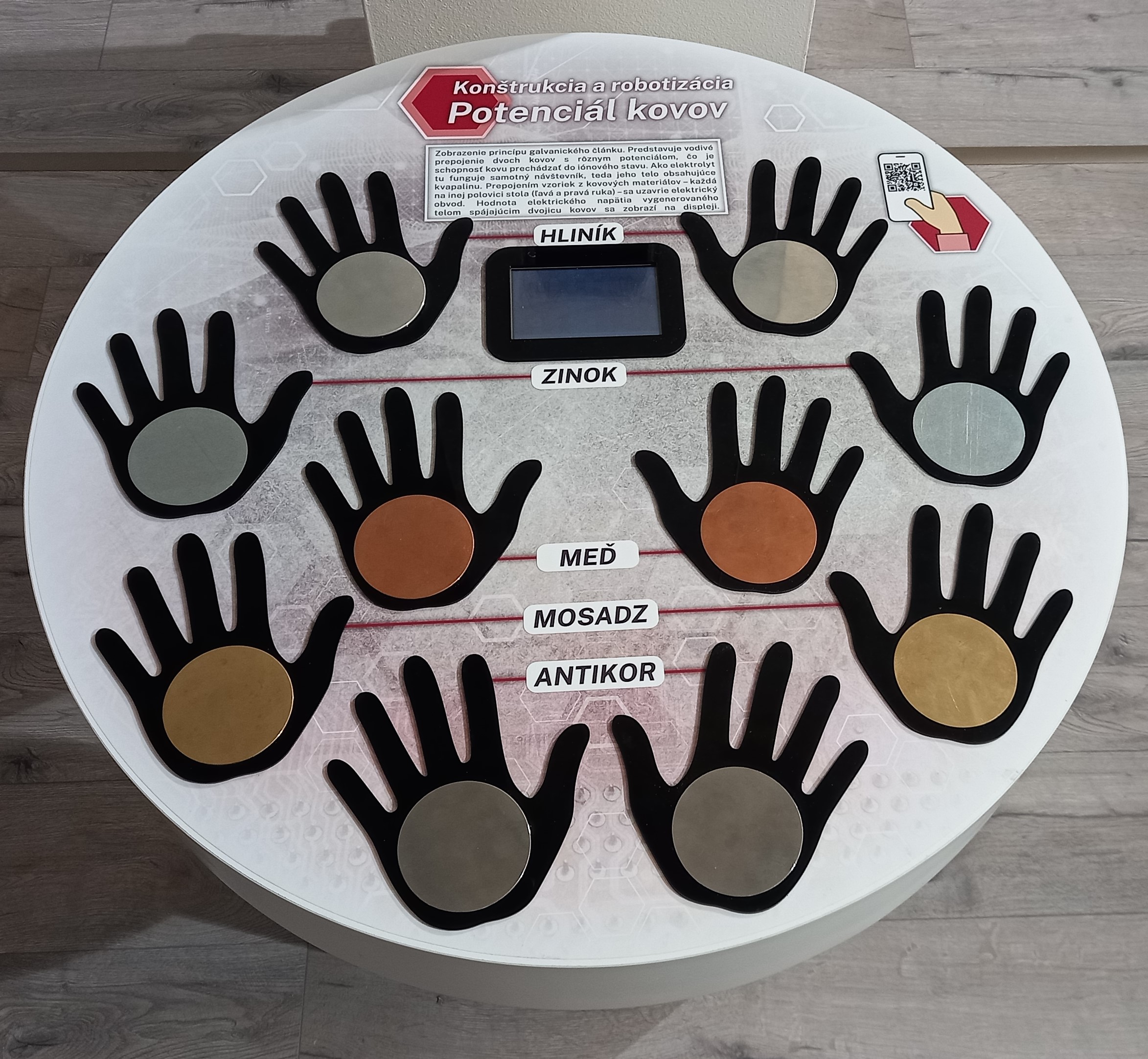
Operating Instructions
- The device switches on automatically, along with other educational and entertainment elements in the MOTIO center.
- Place the palm of your right hand on the metal palmprint on the right side of the table, and the palm of your left hand on the metal palmprint on the left side of the table.
- Your body acts as an electrolyte (conductive liquid) connecting two metals with different—or identical—electrical potentials.
- The result of the interaction (connection) will be displayed on the screen.
Interactivity:
The exhibit functions exclusively through direct contact with the visitor. By simultaneously touching metal samples on both sides of the table (left and right), an electric circuit is completed (closed). The participant’s body acts as the electrolyte. The resulting small electric voltage is displayed. The smallest response is expected when connecting surfaces made of the same material, where no potential difference exists. However, due to environmental influences, a slight deviation may still be indicated even in this case.
Educational Significance:
The value of the standard electrode potential determines a metal’s ability to transition into an ionic state in an electrolyte. Based on this, one can predict the chemical activity of the material in solutions. The more negative the potential, the greater its tendency to dissolve into the solution as cations. Thus, a metal with a more negative potential—considered less noble—reduces ions of a more noble metal with a more positive potential from the solution, while itself oxidizing and entering the solution as a cation. Electrochemistry deals with the course of chemical reactions related to the transformation of chemical and electrical energy. The origins of this field date back to the experiments of Italian physician and physicist Luigi Galvani with frog legs in the second half of the 18th century, laying the foundations of today’s electrical age. It was only a short step from his experiments to Volta’s realization, and the first galvanic cell was born. Alessandro Volta was generous enough to name his invention after the man who inspired him. And that name has remained ever since.
This exhibit aims to clarify the basic phenomenon of electromagnetism by demonstrating the different potentials of metals. It presents a device that illustrates the principle of a galvanic cell, with the human body acting as the electrolyte.
