



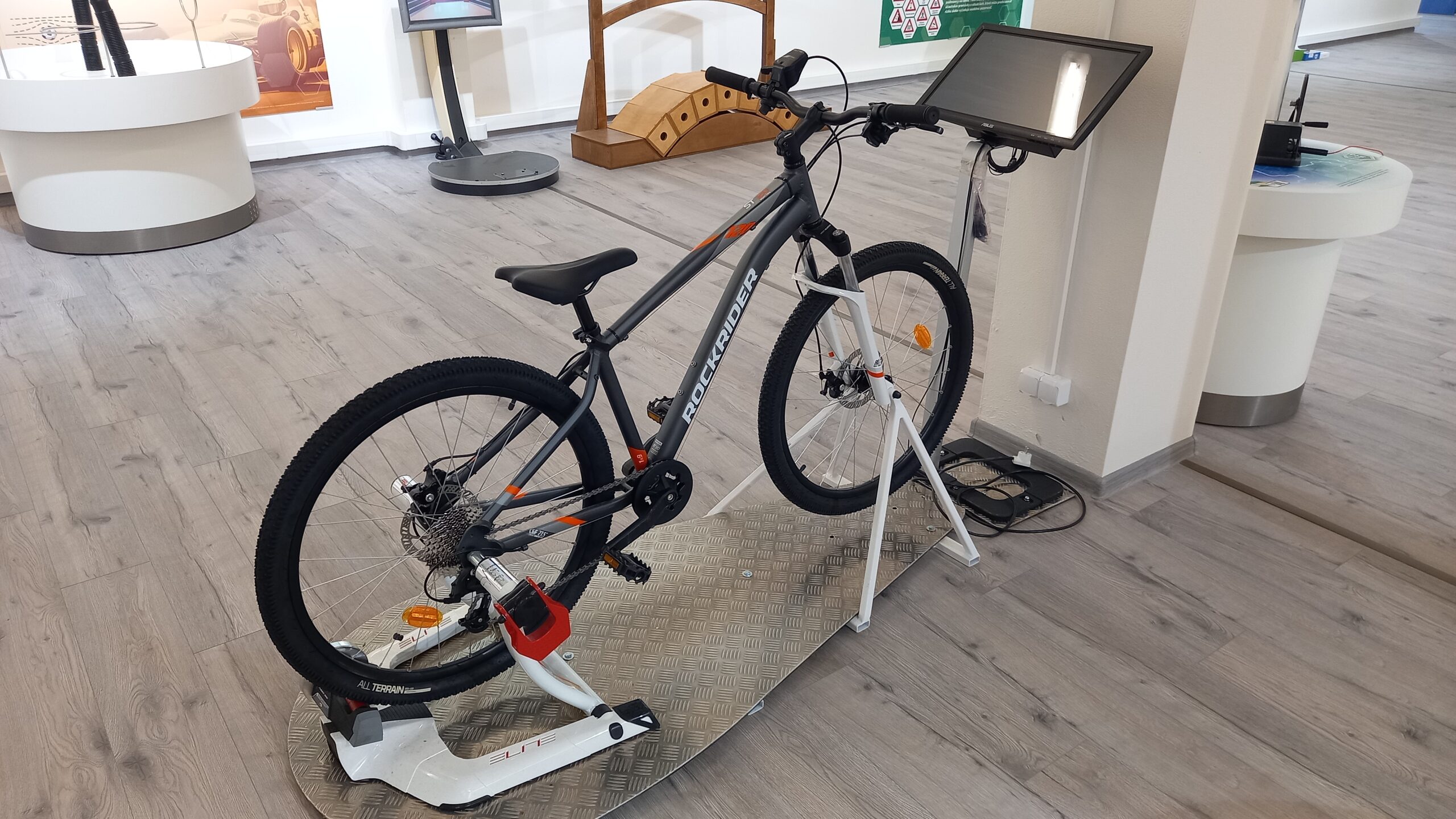
Operating Instructions:
- The device turns on automatically, centrally, along with other educational and entertainment elements in the MOTIO center.
- Adjust the seat height and sit down.
- By pedaling, you start the imaginary ride. The speed of the driven wheel is displayed on the left side of the screen (analog km/h, indicator on the scale) and the distance traveled (digital km, from the rotations and circumference of the wheel).
- The graph on the right side of the screen shows the dependence of time (x-axis – seconds) and power (y-axis – watts) in a continuous process.
- Each rotation of the driven wheel lights up +3 LEDs of the strip. After lighting the entire length, the wavy „filament“ of the bulb graphic gradually lights up, which is the finale of the experiment. There are six intensities the bulb can reach.
Interactivity: The bicycle setup is designed for one participant. After sitting down and pedaling, the rear wheel is set in motion, to which the sensor is attached. From that, the signal travels to the monitor via a computer converter in the form of electrical impulses. The monitor displays information about the activity on the bicycle. The size of the display allows surrounding observers to also monitor the data.
Educational Significance – Concept of the Exhibit:
Every summer, the attractive Tour de France takes place, and people follow the news about the cyclists‘ performances as their groups break away from the peloton or struggle to climb the Alpine hills. There is a big difference between being driven by energy from external sources (a motor unit) and using the power stored in one’s own body. The seemingly large difference in physical context disappears when expressed with basic mathematical formulas and a better understanding of the issue. Like motor vehicles, we convert rotational motion into translational motion. With a bicycle, this is done through pedals. The „Bicycle“ exhibit shows where the energy supply comes from, how it is transformed, and how it is measured. Understanding how much energy a person can produce provides a basic reference for how much power we need to generate electricity with portable devices. Occasionally, trying it out on your own is worth a try. The side effect of such energy production would be movement, which is often in deficit. To start, it is enough to try measuring your own strength and endurance for a while.
