



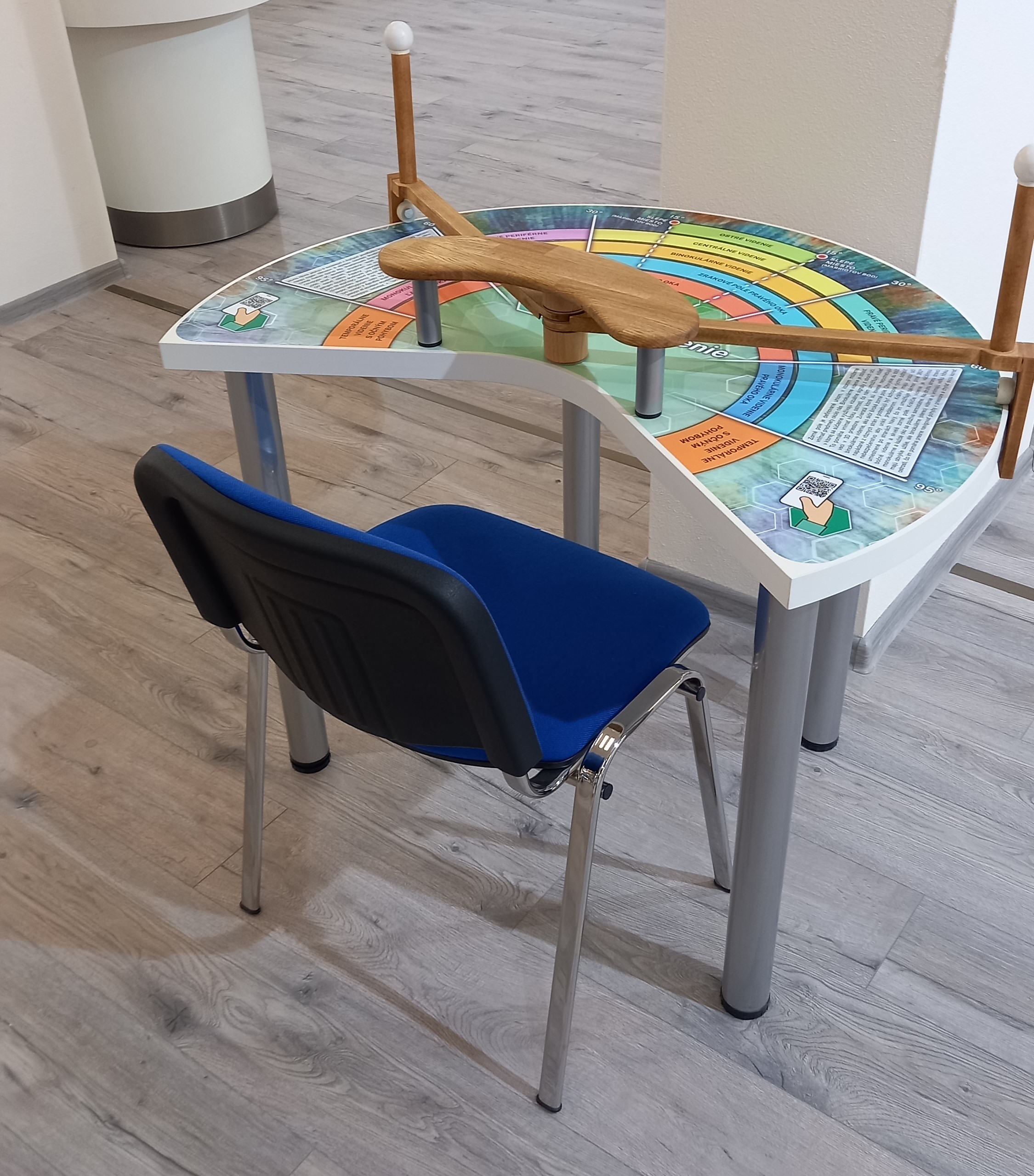
Operating Instructions:
- The exhibit is always in working condition and ready for use.
- Sit at the table and rest your chin comfortably on the center of the raised wooden support (3).
- Grasp the ends of the pivoting arms (2) with your hands. Align both arms toward the center, as close as possible to your direct line of sight.
- Slowly move the arms outward without shifting your gaze—keep looking straight ahead.
- Follow the white tips of the arms until they disappear from your field of vision.
- Carefully return the arms to the position where you can just barely see them at the edge of your vision.
- Leave the arms in that position, stand up, and look at the visual field diagram. There, you can read interesting facts about your visual parameters.
Interactivity:
At this simple, self-service station, visitors can test the width of their peripheral vision by tracking adjustable markers until they are no longer visible. The results can be read on a symmetrical scale, and you can compare them with those of your friends or data from the animal kingdom.
Educational Value – Exhibit Concept:
Peripheral vision refers to the part of our visual perception that occurs outside the center of gaze. It includes a wide range of non-central points in the visual field.
- Far peripheral vision occurs at the outermost edges,
- Mid-peripheral vision is in the middle range, and
- Near peripheral (or para-central) vision is just outside the center of gaze.
In humans, peripheral vision is generally weaker than in many animals, especially in terms of color and shape recognition. This is because the retina contains more receptor cells in the center and fewer at the edges. There are two types of photoreceptor cells: rods and cones. The former are not capable of distinguishing colors and predominate in the peripheral areas, whereas the latter are concentrated mainly in the center of the retina.
The speed of events and the complexity of situations force a person driving a vehicle to make use of all their sensory perception abilities. An informative and entertaining way to test one’s own abilities is offered to visitors by the exhibit Peripheral Vision Test.
The visual field is defined by the angle within which we can perceive objects around us.
Binocular vision is the area where both eyes work together, allowing us to perceive depth and see in 3D.
Prey animals don’t need strong binocular vision as much as they need a wide field of view to detect threats that usually come from all directions. For example, rabbits have eyes on the sides of their heads, giving them nearly 360º side vision. Their vision is mostly monocular, with each eye working independently.
In contrast, predators typically have narrower but binocular (stereo) vision, which provides excellent depth perception—essential for tracking and catching prey.
