



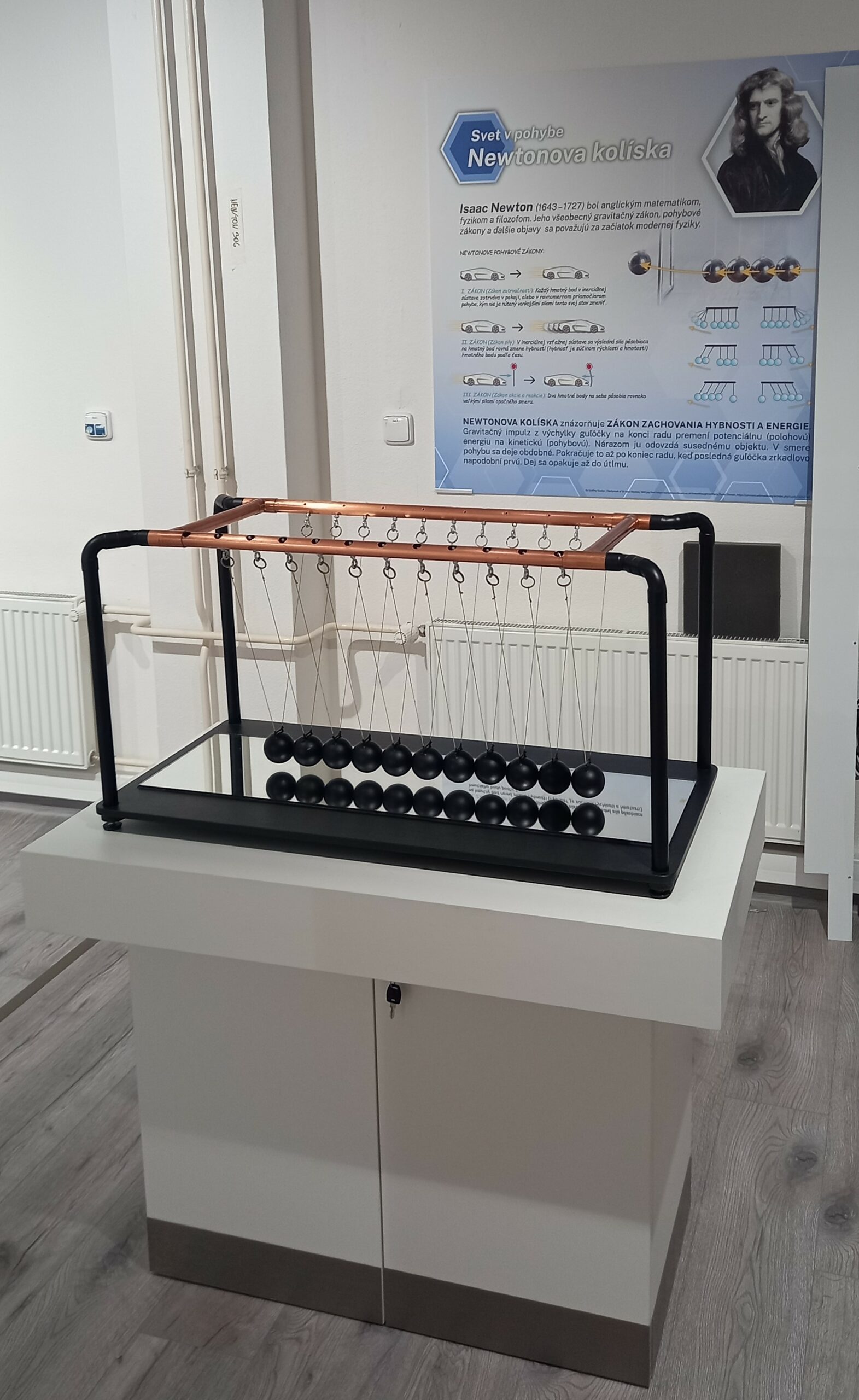
Operating Instructions
- The device is permanently in working condition, ready for operation at any time.
- Displace the first sphere away from the others so that the arms of its suspension string remain taut.
- Release your grip and let the ball freely strike the row of others.
- Observe the process and note the reaction of the balls to the impact.
- After the motion subsides, repeat the experiment by displacing multiple balls. Did you notice any change?
Interactivity:
The exhibit is hands-on. Newton’s cradle (swing) is a device for demonstrating collisions of bodies and the law of conservation of energy and momentum. The experiment demonstrates the law of conservation of momentum, in which one pendulum is displaced. Upon release, it moves and collides with the nearest body. The momentum is gradually transferred from the point of contact to the next ball, following the direction of motion, but only the last weight in the row visibly swings. The balls in between remain stationary. An interesting variation of the experiment is launching an increasing number of end balls and observing the process. The visitor is confronted with the momentum of real bodies and physical laws in a way different from electronic displays, providing space for experiments and new tangible experiences for remembering and understanding phenomena.
Educational Significance – Exhibit Concept: Motion, interaction, and change as essential parts of a process. This applies to both nature and society: everything is interconnected. „No man is an island…“ as Ernest Hemingway once wrote. This applies to life in society and technology. It is up to us to observe our surroundings, understand the law of action and reaction, to account for inertia, and respect the potential of force. All of this is embodied in Newton’s cradle.
Even without an added drive, this mechanical toy and teaching aid can attract attention. It is engaging both acoustically and visually. It invites play and simple exploration. It can spark an interest in physics and natural phenomena. It demonstrates Newton’s law of conservation of energy. After initiating the impact with the end body, the opposite end body bounces, and this repeats until the motion completely subsides. The number of balls in motion at the input displaces the same number at the output. The device is named after the mentioned British physicist, as it is based on the laws of motion he defined. However, the idea of this cradle (1676) comes from Edme Mariotte, a French priest and physicist.
