



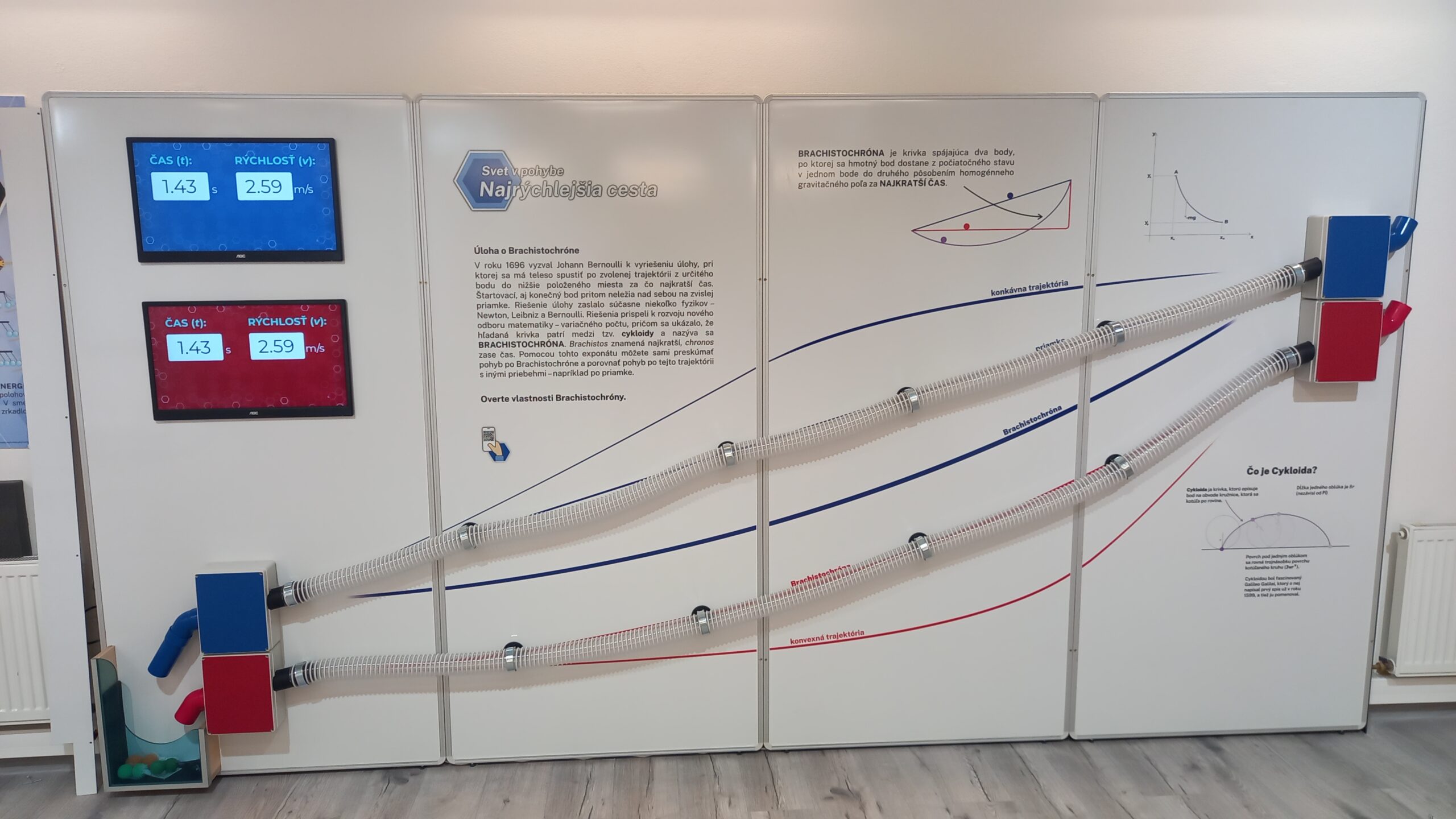
Operating Instructions
The device turns on automatically along with other electronic elements in the MOTIO center. Illuminated monitors with a timer and speedometer indicate the device is ready for use.
Adjust the shape of one or both tracks or test the parameters of the current shapes after removing the balls from the collection basket at the bottom. The holes for inserting the ball are at the top right, one blue and one red, one for each ball. Release the ball freely into the track; it will roll through the tube on its own. The stopwatch and speed calculation will occur automatically, and the result will be displayed on the monitor. Adjust the track by moving the magnetic holders so that the ball reaches the goal in the shortest possible time. Have you discovered which tunnel shape transfers the object the fastest?
Interactivity:
The exhibit is interactive, transparent, with applied electronic elements, slightly competitive, and experimental. It demonstrates the use of a curve called the Brachistochrone and its potential use in technical practice. The curve, under the influence of a homogeneous gravitational field, allows the shortest rolling time of an object on an inclined plane from the starting point to the end point. Interestingly, it is not the expected straight line but a symmetrical part of a cycloid.
Educational Significance – Exhibit Concept:
Mathematics is a scientific field that, at a higher level, with its seemingly extreme complexity in solving problems using abstract methods, deters many promising students from examining it further and enhancing their knowledge and skills. It must be acknowledged that it has developed dynamically from the beginning, and descriptions and explanations of some phenomena were not readily available. Even in the 17th century, leading researchers faced challenges that led to the emergence of a new theory of mathematical analysis – the Calculus of Variations. The task was to determine the path connecting two points in a vertical plane along which a material object would move under the influence of gravity (hypothetically without resistance) so that it would reach the lower point in the shortest time possible. They based their work on the principle of light refraction in media with different optical densities. At their interface, the beam propagates so as not to lose even a fraction of time in overcoming the distance. Thanks to this theory, we now have the best means of motion control, and, at the same time, space technologies that facilitate our daily activities. The practical verification of the curve calculation determining the fastest transfer path is offered by the Brachistochrone exhibit – the fastest route.
