



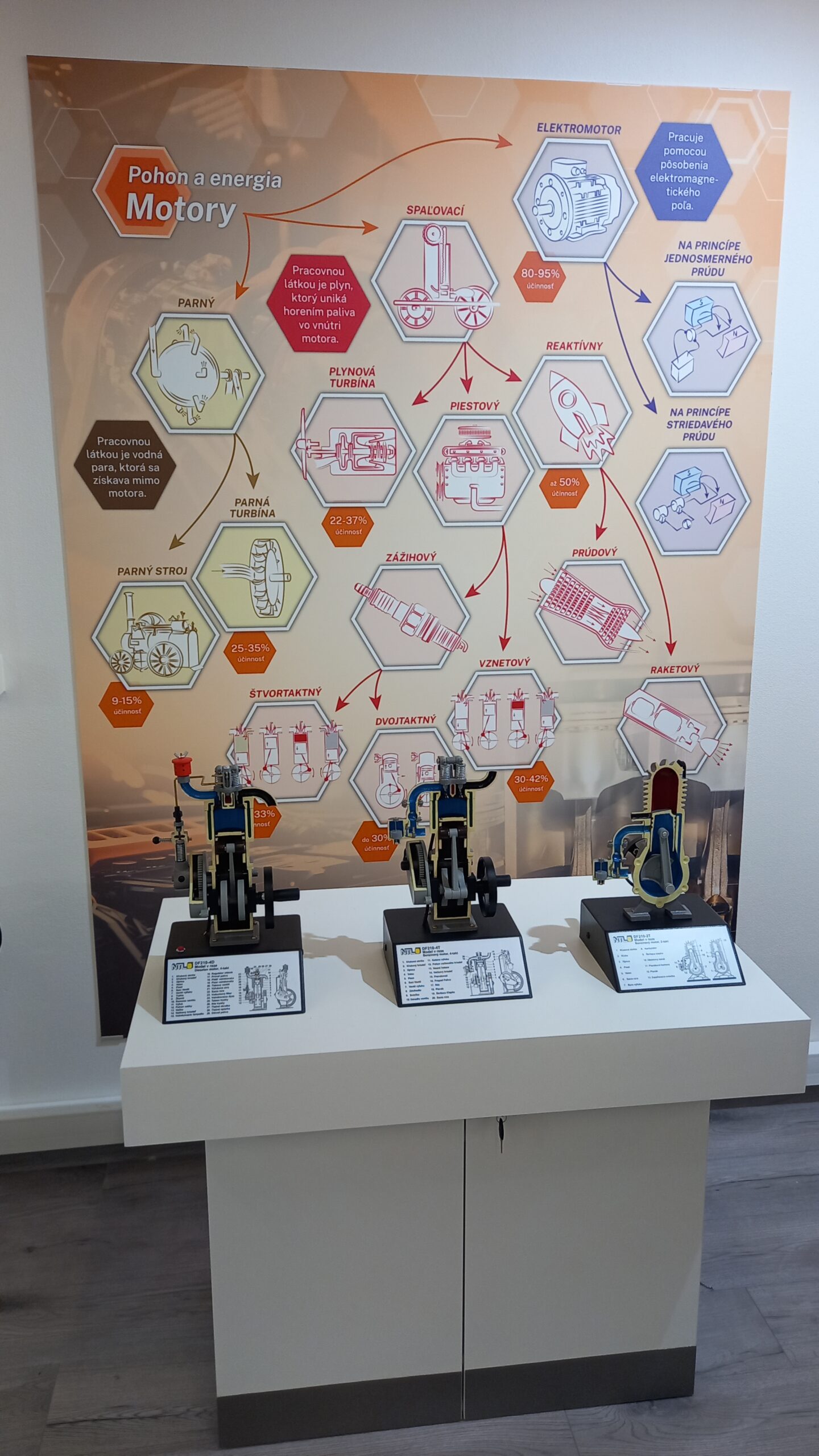
Operating Instructions:
- The composition is permanently in working condition, always ready for operation.
- Gently rotate the crank of any engine model.
- Stop at the extreme positions of the pistons (top dead center, bottom dead center), observe the operation of the valves and the ignition of the mixture symbolized by the light of a small bulb (red backlight).
- Try to identify the individual phases of the engine’s operation and notice the difference between 2-stroke and 4-stroke.
Interactivity: Open models let the observers see the work of piston combustion engines and activities in detail, stroke by stroke. The participant, while slowly rotating the auxiliary crank, observes the processes in the combustion chamber. The ignition is symbolized by a light effect. One can also observe the activities of regulatory and control mechanical systems that ensure the control of thermal processes.
Educational Significance: The dynamic development of transportation starting from the early 20th century was enabled by piston combustion engines. Not only did they move ground transportation into a completely different category of usability, but they also had a significant impact on rail, maritime, and air transport. Their widespread use and noticeable impact on the environment, as well as the decreasing reserves of fossil fuels, force society to reduce their use and seek alternatives. However, they still constitute most mobile energy sources. This illustrative, open engine model brings closer the internal structure of the combustion chamber and control mechanisms related to the operation of this type of propulsion.
