



Operating Instructions
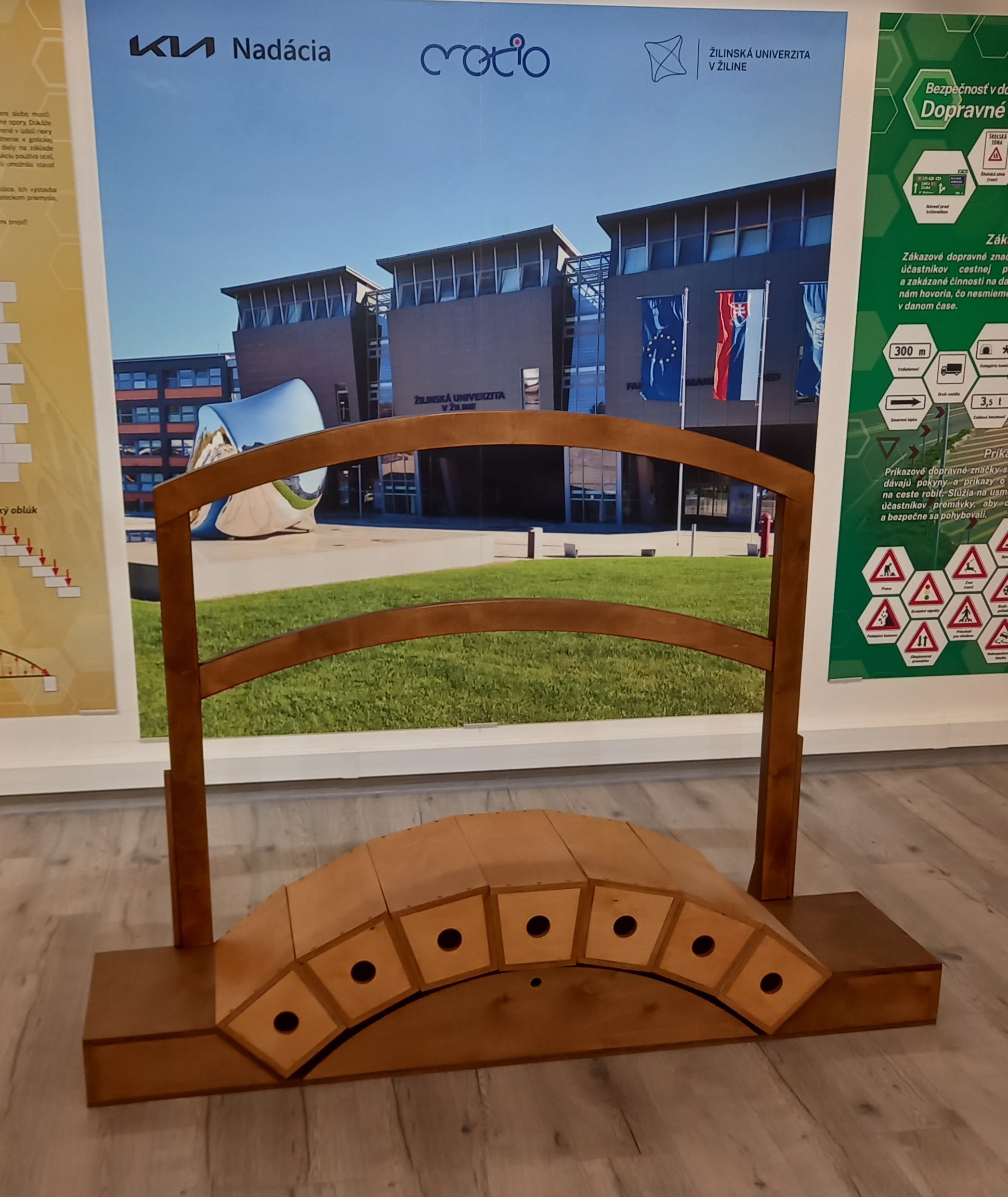
- The exhibit is permanently in working condition and ready for use at any time.
- Begin with the disassembled setup — just the segments (1).
- With the side supports flipped up vertically (perpendicular to the floor), start building the arch structure from the edges using the segments (1), in a single row.
- Once all 7 segments are placed between the fixed points in a stable arrangement, lower the auxiliary supports (3) on both sides.
- To test stability, press down on the top of the arch with your hand.
- If the structure is solid, you may step onto it. The railing is there to support your balance and enhance safety.
Interactivity:
In its disassembled state, the exhibit consists of two fixed points representing the “banks” of the future bridge. To simplify the activity and reduce the number of participants needed to assemble the arch, a rounded auxiliary structure with temporary support is provided. The segments of the future bridge arch are interchangeable, making construction easier for less experienced builders. Using only the strength of their hands, logic, imagination, and skill, participants can assemble the segments into an arch that bridges both “banks.” Once the auxiliary arch support is lowered on both sides, individuals can walk across the footbridge and test the strength and rigidity of the arch construction principle. As a bonus, visitors can take a photo on the bridge with a graphic backdrop of the UNIZA campus.
Educational Purpose:
In addition to the diverse combinations of genes and resulting variety of traits and appearances, our ancestors passed us down a wealth of knowledge and wisdom. We live surrounded by modern technologies and, being connected to nearly the entire world, we encounter new challenges every day, and we handle them. Overcoming obstacles, gaining experience, transforming exploration into knowledge, and striving to improve the quality of life have accompanied humanity since ancient times. One result of the flexibility and ingenuity of ancient builders is the use of the arch as both a structural and architectural element. This design genius has traveled through time via bridges, aqueducts, grand buildings, and cellars, reaching our present day in both original and modified forms. We continue to create and use it in various fields — aerospace, automotive engineering, water infrastructure, monumental architecture, and many others. The arch structure is fundamentally simple, and even a child can assemble it and test its strength. The Roman Arch exhibit offers this opportunity.
