



Operating Instructions
- The device is permanently in working condition, ready for operation at any time.
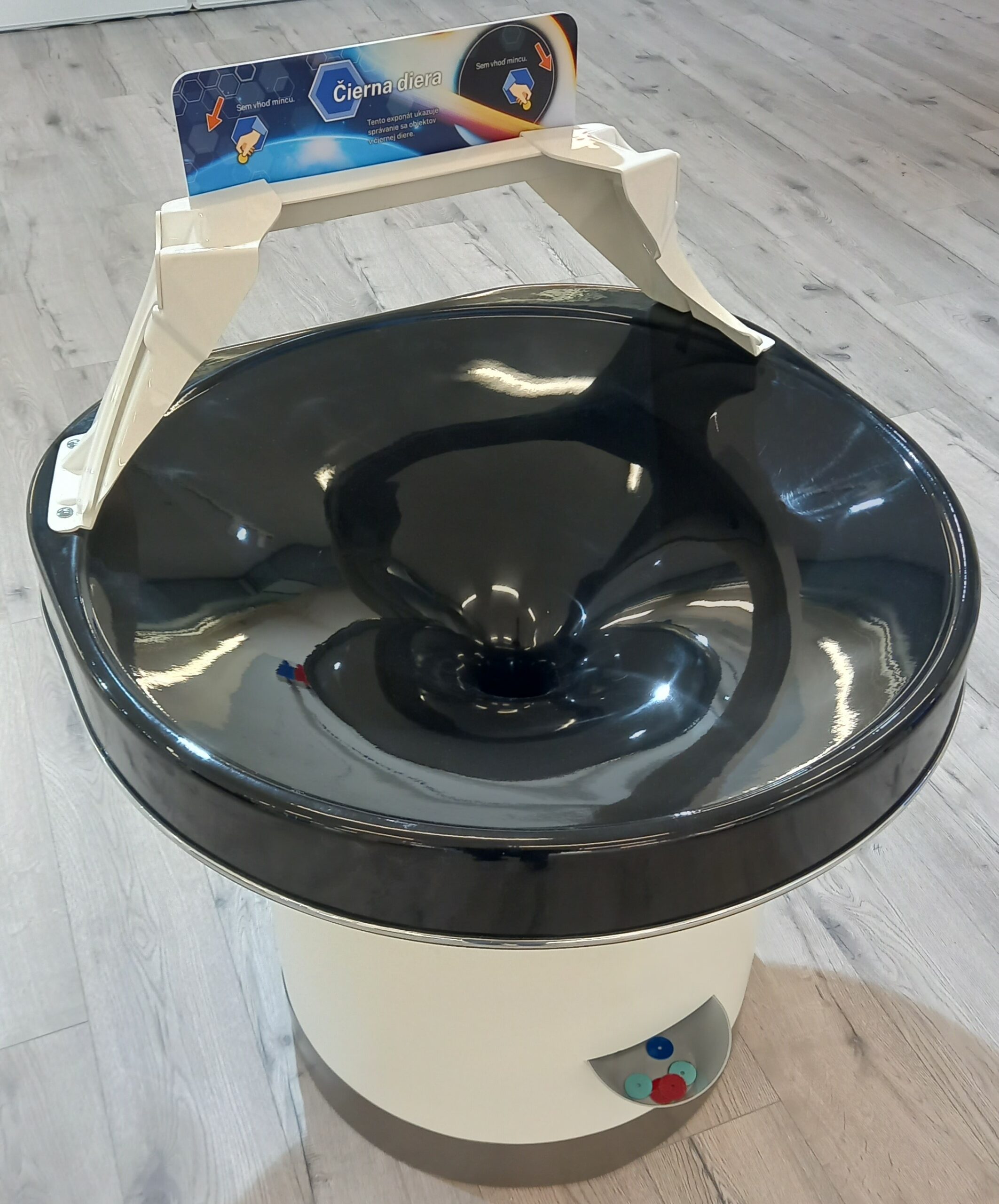
- Remove the objects from the groove on the cylindrical leg. (You can also use your own coins. The exhibit will return them.)
- Vertically insert them into the slots on the sides of the white extension – the launch ramp, each separately.
- Let them slide down into the large funnel by gravity, and they will then spiral down the hyperboloid.
- Insert additional objects from the right and left, one at a time, with intervals or quickly one after another. They will circle, collide, and fall.
- You can compete to see whose object stays above the hole the longest.
- Influence the variable values, observe the phenomena, and try to deduce their laws (object masses, number, speed, path, collision probability, etc.).
Interactivity: Visitors, either in small groups or individually, place a coin (a flat round disc) into the side groove of the ramp and release it. The object, after an initial gravitational start, spirals down into the central hole, where it eventually falls into the funnel’s center and ends up in the collection container. Coins can be launched from right to left, vice versa, or simultaneously in both directions. After the motion ends, they are accessible again.
Educational Significance – Exhibit Concept:
Physics has come a long way from the beginnings of scientific research and the first attempts to define basic, universally valid rules, on which today’s mechanics are also based. One of the pillars of the development of current scientific knowledge, from the level of exploring cosmic laws to solving multi-layered technical problems, is understanding the action of the gravitational force. The Black Hole model offers an engaging and entertaining depiction, drawing visitors into this aspect of the world of physics. It provides safe simulations of collisions, force compositions, the ability to observe the diversity of object dynamics when changing mass or impulse to gain speed, and the consequences of exceeding the permissible parameters of centrifugal force – all useful knowledge for understanding everyday phenomena.
