


Operating Instructions:
- The device turns on automatically, centrally, along with other entertainment elements in the MOTIO center.
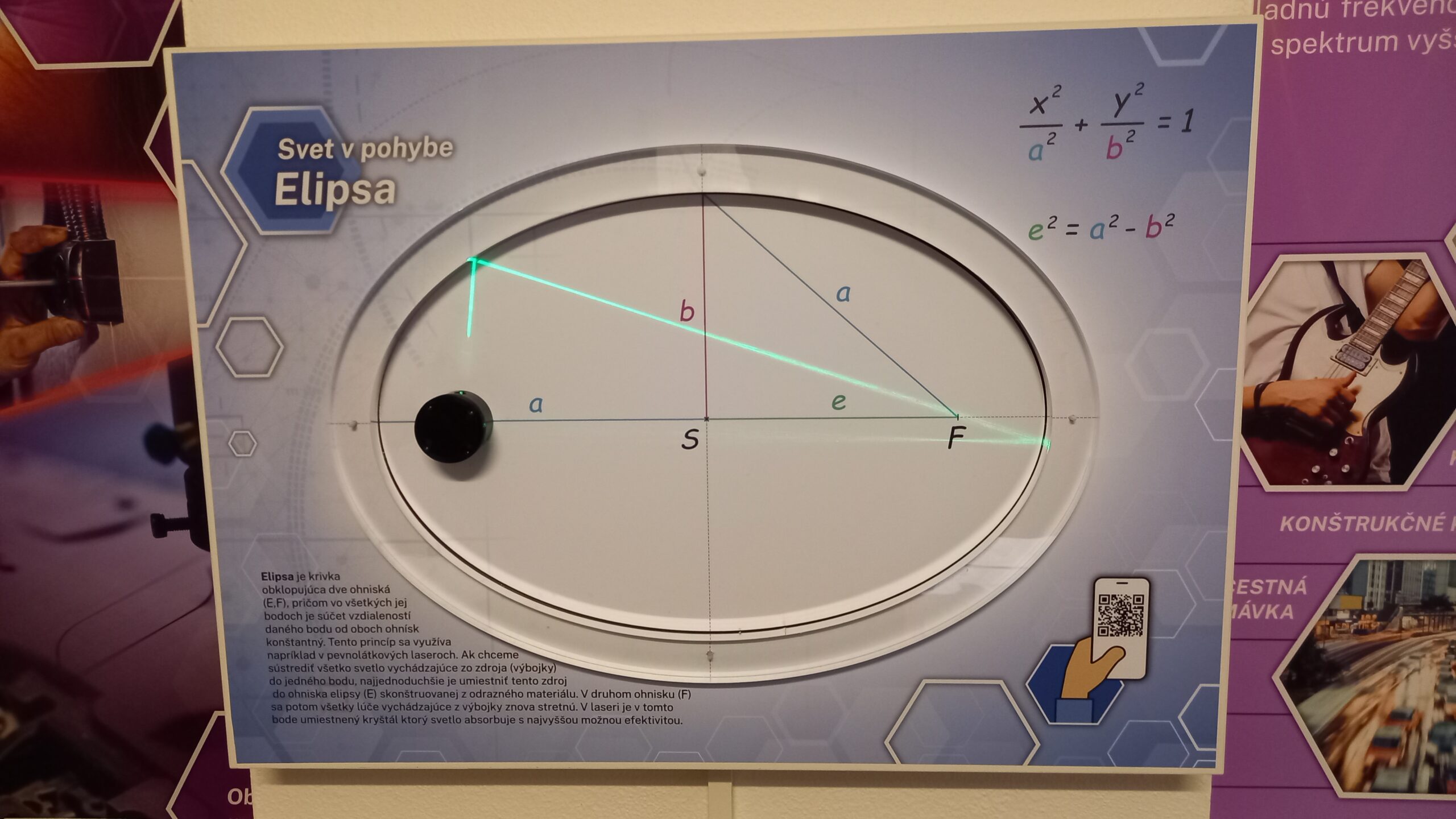
- Gently rotate the laser source in the left focus of the ellipse to direct the beam to the inner edge of its frame.
- Observe through which point the beam’s reflection passes.
- Does this point change when the angle of reflection changes? Could you draw an ellipse based on this observation?
Interactivity: With the effective help of a safe laser beam coming from a rotating source placed in one of the foci, it is confirmed that an object (beam, wave) moving from one focus will reflect (law of incidence and reflection) off the wall of the ellipse in such a way that it always passes through the second focus. The measurable length of the beam’s trajectory is the same at every moment. This experiment provides repeated testing opportunities and a simple, definitive understanding.
Educational Significance: A perfect circle is a good thing. It has proven itself in various areas, such as transportation and logistics (e.g., wheels, gears), furniture and interior equipment (tables, flower pots, clocks, lamps, glasses, plates, etc.), sports (gymnastics, ball sports), and many others. However, in nature, a perfect circle is hard to find – there is often a “but.“ Its relative, the ellipse, initially complicated our calculations, but we overcame it and mastered it. The ellipse is a plane curve without which we cannot imagine many areas of natural and technical sciences, with an emphasis on astronomy. From a certain angle, a circle can also appear as an ellipse. Just shine a round flashlight lens on a surface at an angle other than a right angle. It is defined as the sum of all points in the Euclidean plane whose sum of distances from two fixed points is constant. This theorem is confirmed by the interactive exhibit unsurprisingly named Ellipse.
